Shortage vs Surplus: The Two States of Disequilibrium

Jude Wallis
Founder of EconLearn · 2nd place internationally at the Economics Olympiad (econolympiad.org)
A shortage occurs when quantity demanded exceeds quantity supplied, which happens at a price below equilibrium. A surplus is the reverse: quantity supplied exceeds quantity demanded at a price above equilibrium. Both are disequilibrium states, and in a free market the price rises or falls to erase the gap.
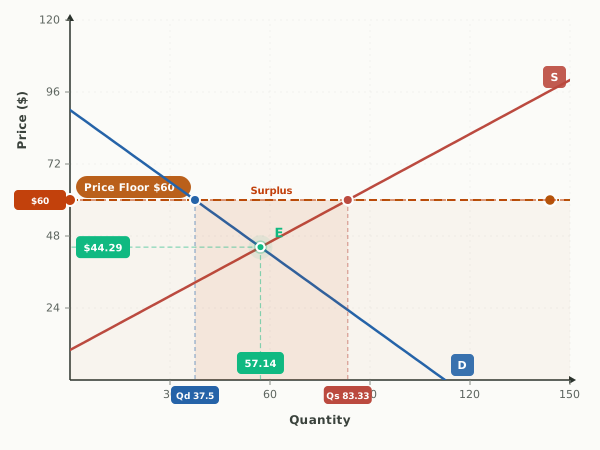
A $60 floor sits above the $44 equilibrium, so sellers offer more than buyers take: the gap is a surplus. Drag the floor below equilibrium to see it vanish, then try a ceiling for the shortage. Or open the full version, or put it on your own site free, or turn it into a five-minute class activity.
The two are the ways a market can be out of balance. This guide works through both with real numbers, shows exactly how prices adjust back to balance, and explains why price controls can freeze a shortage or surplus in place. See shortage (excess demand) and surplus (excess supply).
Start from equilibrium
A market is in equilibrium when the quantity demanded equals the quantity supplied, so there is no pressure on the price to change. The price where that happens is the equilibrium price, and the quantity is the equilibrium quantity. See market equilibrium. Shortages and surpluses are simply what you get when the actual price is not the equilibrium price.
Here is a demand and supply schedule for a market in coffee mugs. Quantity demanded falls as price rises, following the law of demand, and quantity supplied rises as price rises, following the law of supply.
| Price | Quantity demanded | Quantity supplied | Result |
|---|---|---|---|
| $2 | 100 | 20 | Shortage of 80 |
| $4 | 80 | 40 | Shortage of 40 |
| $6 | 60 | 60 | Equilibrium |
| $8 | 40 | 80 | Surplus of 40 |
| $10 | 20 | 100 | Surplus of 80 |
Equilibrium is at $6, where both quantity demanded and quantity supplied equal 60. Every other price produces a gap.
Working out a shortage
Look at the $4 row. Buyers want 80 units but sellers only offer 40, so quantity demanded exceeds quantity supplied by:
Shortage = Quantity demanded - Quantity supplied = 80 - 40 = 40 units
At this low price the good is a bargain, so lots of people want it, but few sellers find it worth supplying. Shelves empty, waiting lists form, and some willing buyers go home empty-handed. That frustrated demand is the signal of a shortage.
Drop the price further, to $2, and the shortage grows to 100 - 20 = 80 units. The lower the price below equilibrium, the bigger the shortage. This is why a shortage is a low-price problem, not a sign that the good is scarce in some absolute sense.
Working out a surplus
Now look at the $8 row. Sellers offer 80 units but buyers only want 40, so quantity supplied exceeds quantity demanded by:
Surplus = Quantity supplied - Quantity demanded = 80 - 40 = 40 units
At this high price sellers are eager to produce, but the steep price scares off buyers. Unsold inventory piles up in warehouses. Raise the price to $10 and the surplus widens to 100 - 20 = 80 units. A surplus is a high-price problem: the further price sits above equilibrium, the more goes unsold.
How prices adjust back to equilibrium
In a free market, a shortage or surplus does not last, because the imbalance itself pushes the price toward equilibrium.
A shortage pushes the price up. When buyers compete for too few goods at $4, some offer to pay more, and sellers happily raise prices. As the price rises from $4 toward $6, two things happen at once: quantity demanded falls (from 80 toward 60) because the good is now pricier, and quantity supplied rises (from 40 toward 60) because production becomes more profitable. The gap shrinks from both sides until it closes at $6.
A surplus pushes the price down. When sellers are stuck with unsold mugs at $8, they cut prices to move inventory. As the price falls from $8 toward $6, quantity demanded rises (from 40 toward 60) and quantity supplied falls (from 80 toward 60). Again the gap closes at equilibrium.
This self-correction is the reason economists treat equilibrium as the market's resting point. You can watch it happen by dragging the curves in the supply and demand sandbox, and the full model is covered in our supply and demand guide.
When the adjustment is blocked: price controls
The self-correcting story assumes the price is free to move. Price controls are government limits that stop it, and they are the main reason a shortage or surplus can persist instead of vanishing.
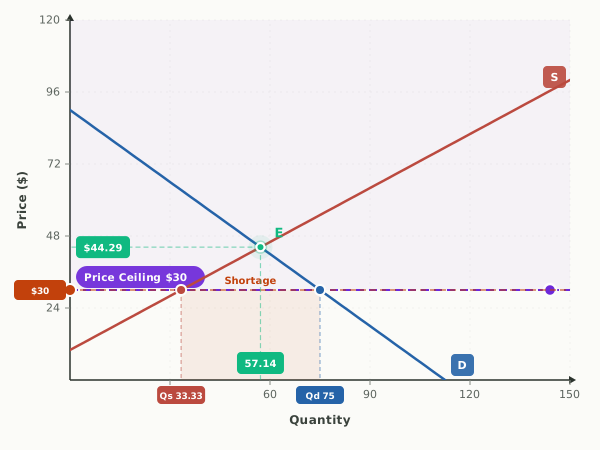
A price ceiling causes a lasting shortage. A price ceiling is a legal maximum price. To have any effect it must be set below equilibrium, which is called binding. Suppose the government caps mug prices at $4. From the table, quantity demanded is 80 and quantity supplied is 40, a shortage of 40 that cannot self-correct, because the price is legally forbidden from rising to $6. The shortage is now permanent. Rent control is the classic real-world example: capped rents below the market rate produce a lasting shortage of apartments.
A price floor causes a lasting surplus. A price floor is a legal minimum price, and to bind it must sit above equilibrium. Suppose mugs get a floor of $8. Quantity supplied is 80 and quantity demanded is 40, a surplus of 40 that cannot clear, because the price is forbidden from falling to $6. The minimum wage is a price floor in the labor market: set above the equilibrium wage, it produces a surplus of labor, which is unemployment. Agricultural price supports create surpluses of crops the government then has to buy or store.
For the full treatment of how ceilings and floors work, including their effect on total surplus and deadweight loss, see our guide on price controls: ceilings, floors, shortages, and surpluses.
Do not confuse a shortage with scarcity
Two quick clarifications the exam rewards. A shortage is not the same as scarcity. Scarcity is the permanent condition that resources are limited relative to wants, and it applies to every good all the time. A shortage is a temporary, price-specific mismatch that disappears when the price rises to equilibrium. A market at equilibrium still faces scarcity but has no shortage.
Similarly, a market surplus is not the same as a firm's producer surplus or a wasteful oversupply in a moral sense. A market surplus is just quantity supplied exceeding quantity demanded at a too-high price, and it clears when the price falls.
Summary
A shortage is excess demand at a price below equilibrium; a surplus is excess supply at a price above equilibrium. Compute each as the simple difference between quantity demanded and quantity supplied at the going price. In a free market the price rises to erase a shortage and falls to erase a surplus, both pushing back toward the equilibrium where quantity demanded equals quantity supplied. The exception is price controls: a binding price ceiling locks in a shortage and a binding price floor locks in a surplus. Practice the adjustment on the supply and demand sandbox and lock in the vocabulary in the glossary.
Frequently asked questions
What is the difference between a shortage and a surplus?
A shortage (excess demand) happens when quantity demanded exceeds quantity supplied at the current price, which occurs when the price is below equilibrium. A surplus (excess supply) happens when quantity supplied exceeds quantity demanded, which occurs when the price is above equilibrium. A shortage is a low-price problem and a surplus is a high-price problem; both are states of disequilibrium that push the price back toward equilibrium.
How do you calculate a shortage or surplus?
Take the quantity demanded and quantity supplied at the given price and subtract. A shortage equals quantity demanded minus quantity supplied when demand is larger. A surplus equals quantity supplied minus quantity demanded when supply is larger. For example, if at $4 buyers want 80 units and sellers offer 40, the shortage is 80 minus 40, or 40 units.
How does a market fix a shortage or surplus on its own?
The imbalance changes the price. A shortage makes buyers bid the price up, which reduces quantity demanded and increases quantity supplied until the gap closes at equilibrium. A surplus makes sellers cut the price to clear inventory, which increases quantity demanded and reduces quantity supplied until the market returns to equilibrium. The price stops moving only when quantity demanded equals quantity supplied.
What causes a shortage that does not go away?
A binding price ceiling, which is a legal maximum price set below equilibrium. Because the price cannot legally rise to clear the market, quantity demanded stays above quantity supplied and the shortage persists. Rent control is the classic example. The mirror case is a binding price floor, set above equilibrium, which locks in a lasting surplus, as the minimum wage does in the labor market.
Is a shortage the same as scarcity?
No. Scarcity is the permanent fact that resources are limited relative to human wants, and it applies to every good at all times, even at equilibrium. A shortage is a temporary mismatch at a specific price that is below equilibrium, and it disappears once the price rises to the equilibrium level. Scarcity never disappears; a shortage does.
More on shortage vs surplus
- CalculatorHow to Calculate a Price Ceiling Shortage
- CalculatorPrice Floor Surplus = Qs − Qd
- CalculatorShortage Formula: Qd − Qs at a Set Price
- Quick answerHow do supply, demand, and price respond to a surplus?
- For teachersShortage and Surplus Worksheet with Answers
- CompareQuantity Supplied vs Surplus (Excess Supply)
- CompareScarcity vs Shortage (Excess Demand)
- CompareShortage (Excess Demand) vs Deadweight Loss
- DefinitionBinding vs. Non-Binding Price Control, AP Economics
- DefinitionShortage (Excess Demand), AP Economics
- DefinitionSurplus (Excess Supply), AP Economics
Next in the course
Use what you just learned
Put the live graph in front of students
Copy the exact interactive graph for a class site or LMS, or turn it into a short prediction activity with one student link.
Get new study guides in your inbox
Occasional emails with new posts, study tips, and exam-season reminders. Free, no spam.
No spam. Unsubscribe anytime. Read our privacy policy.
Teaching this topic? Every interactive graph on this site can be assigned as a graded activity with scores in your gradebook, and the classroom tools are free to pilot. No student accounts are needed for the graphs themselves.