What assumptions does a PPC make?
A production possibilities curve rests on four assumptions: two goods, a fixed quantity of resources, fixed technology, and full and efficient use of those resources, plus a fixed time period; each one strips out real-world detail so one graph can show the tradeoff between two outputs.
Full guide: The PPC, explained with graphs and examples
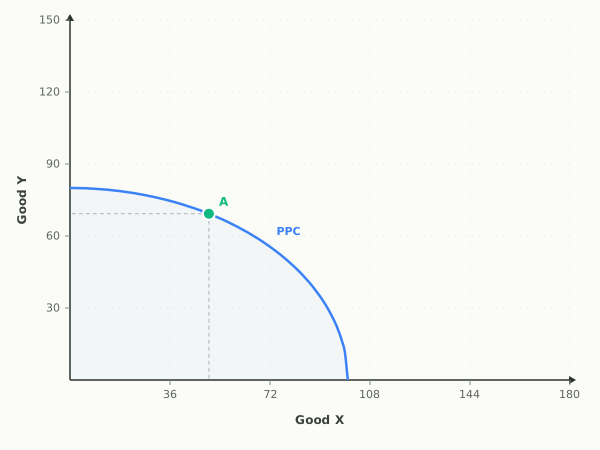
A production possibilities curve, or PPC, only works as a teaching graph because it rests on four core simplifying assumptions at once: two goods only, a fixed quantity of resources, fixed technology, and full and efficient use of those resources, plus an implicit fixed time period. Drop any one of them and the clean bowed or straight line most students learn stops describing anything real. The assumptions are not a flaw in the model; they are the reason the model can fit on two axes at all.
The two-goods assumption exists because a graph has only two axes. Every unit not spent on good A frees up resources for good B, so the curve can show a full menu of combinations on one page. Relax it and a real economy makes thousands of goods at once; economists handle that by grouping output into two categories, such as consumer goods and capital goods, or by holding every other good constant and asking only about the tradeoff between two at a time.
Fixed resources means the land, labor, capital, and entrepreneurship available to the economy do not change while you read the graph. That assumption is what makes the curve a single, stable boundary rather than a moving target. Relax it, by discovering new farmland, growing the labor force, or building more factories, and the whole curve shifts outward: more of both goods becomes possible at every combination, which is the graph's way of showing economic growth.
Fixed technology means the methods for turning resources into output do not improve while the curve is drawn. This assumption isolates the tradeoff between two goods from a separate story, technological progress, that would also shift the curve outward on its own. Relax it and an invention that raises output per worker in one or both goods pushes the frontier out the same way added resources do, so growth on a PPC always comes from more resources, better technology, or some mix of the two.
Full and efficient use of resources is what puts the economy on the curve rather than somewhere inside it. A point inside the curve represents unemployed workers, idle machines, or resources used in the wrong jobs, so more of both goods could be produced without giving anything up. Relax the assumption, as a recession does, and the economy sits inside the curve even though the frontier itself has not moved; that is the graph's distinction between a slowdown, a movement toward the interior, and a permanent gain in capacity, a shift of the curve.
The fixed time period is less a standalone assumption than a corollary of holding resources fixed: it ties the whole picture to one span, usually a year, so that resources committed to good A cannot also be counted toward good B later in the same period. Each of the four core assumptions, plus that implicit time period, is a deliberate simplification, not a claim about how a real economy behaves, and this walkthrough of the production possibilities curve works through the shapes, the shifts, and the opportunity cost math that follow once the assumptions are in place.
Go deeper
Related questions
- Why does a PPC only show two goods?
- Because the graph has only two axes. Economists compress a whole economy into two categories, like consumer goods and capital goods, so the tradeoff between them can be drawn on a single page.
- What happens to the PPC if resources or technology increase?
- The entire curve shifts outward, showing that more of both goods can now be produced at every combination. That outward shift is how a PPC represents economic growth.
- What does a point inside the PPC mean?
- It means resources are not fully or efficiently used, such as during unemployment. More of both goods could be produced without sacrificing either one, which is why points inside the curve are attainable but not efficient.
- Is the full and efficient use assumption realistic?
- No, and that is intentional. Real economies rarely sit exactly on their frontier; the assumption sets a benchmark so movements toward or away from the curve can be measured and explained.
More questions answered
Last updated