How to Calculate the Surplus from a Price Floor
A price floor creates a surplus equal to quantity supplied minus quantity demanded at the floor price, and only the smaller amount, Qd, is actually sold.
Full guide: Shortage vs surplus, with graphs
The Price Floor Surplus formula
Worked example: Price Floor Surplus
A labor market has quantity of labor demanded Qd = 500 − 10W and quantity of labor supplied Qs = 20W − 100, where W is the hourly wage. Setting Qd equal to Qs gives equilibrium wage W = $20 and equilibrium quantity 300 workers. A minimum wage of $25 sits above equilibrium, so it binds. At W = 25, Qd = 500 − 10(25) = 250 and Qs = 20(25) − 100 = 400, so the surplus of labor is 400 − 250 = 150 workers. That surplus is unemployment: 150 people want a job at $25 an hour but only 250 jobs exist. If the same law set the minimum wage at $15 instead, it would sit below the $20 equilibrium and do nothing, because employers were already paying $20.
Calculator
Enter a labor market's demand and supply lines and a minimum wage to get the surplus of workers it creates.
Quantity supplied minus quantity demanded at the floor: workers who want the job at that wage but do not get it.
- Equilibrium wage
- $20
- Equilibrium quantity
- 300
- Quantity demanded at the floor
- 250
- Quantity supplied at the floor
- 400
Also the number of workers actually hired.
How to calculate Price Floor Surplus, step by step
- 1Check that the floor binds. A price floor changes the market only when it is set above the equilibrium price. A floor set at or below equilibrium is non-binding, because the market already trades above it, so demand and supply behave as if the floor were not there.
- 2Find quantity supplied at the floor. Substitute the floor price into the supply equation, or read straight off the supply curve, to get Qs, the quantity sellers offer at that price.
- 3Find quantity demanded at the floor. Substitute the same price into the demand equation, or read off the demand curve, to get Qd, the quantity buyers want at that price.
- 4Subtract to get the surplus. Surplus = Qs − Qd. Sellers are the long side of the market, so only Qd units actually change hands; the rest go unsold, or, in a labor market, unemployed.
Why a floor below equilibrium does nothing
A price floor is a legal minimum: sellers may charge more than the floor but never less. If the floor sits below the price the market would set on its own, it imposes no real constraint, because buyers and sellers keep meeting at the equilibrium price and quantity, and a floor sitting under an outcome the market already produces never stops anyone from trading there.
Take a labor market where the equilibrium wage is $20 and the equilibrium quantity is 300 workers. A minimum wage of $15 is a legal floor in the sense that no employer may pay less than that, but no employer wants to pay less than $20 in the first place, since $20 is the wage that clears the market on its own. Quantity supplied and quantity demanded stay equal at 300, and there is no surplus.
Only a floor set above equilibrium changes anything, because only then does it stop the wage from settling at the level where quantity supplied and quantity demanded match.
Reading the surplus off the graph
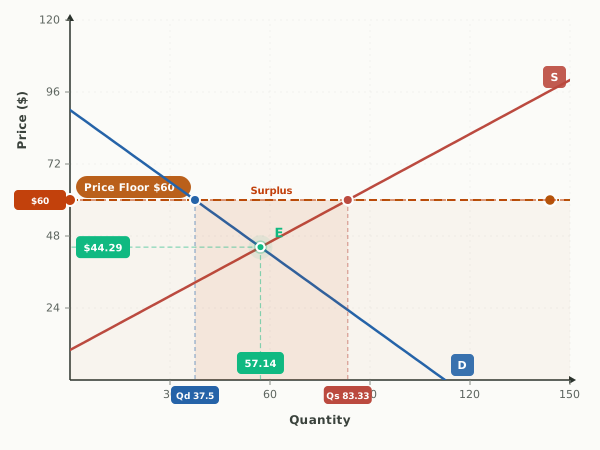
On a standard supply and demand graph, draw the floor as a horizontal line above the equilibrium point. That line crosses the supply curve at one quantity and the demand curve at a smaller quantity, since a higher price pulls more sellers in while pushing buyers out.
The rightmost of those two crossings, on the supply curve, gives Qs: how many units sellers want to offer at the floor price. The leftmost, on the demand curve, gives Qd: how many units buyers want at that price. The surplus is the horizontal gap between them, measured along the floor line, stretching from the demand curve to the supply curve.
Only Qd units actually sell, since a trade needs both a willing buyer and a willing seller, and there are only Qd willing buyers. The stretch of the supply curve to the right of Qd, sellers who wanted to sell at that price but found no buyer, is the unsold surplus itself.
Price Floor Surplus questions
Why does a price floor below equilibrium do nothing?
The market price already sits above a floor set below equilibrium, so the floor never binds. Quantity supplied and quantity demanded stay equal at the equilibrium point, and no surplus appears.
Why does a minimum wage create unemployment rather than a shortage?
A minimum wage is a price floor on labor. Above the equilibrium wage, quantity of labor supplied exceeds quantity of labor demanded, and that gap, people who want a job at the going wage but cannot find one, is unemployment.
How do you read the surplus off the graph?
Draw a horizontal line at the floor price above the point where supply and demand cross. Where that line meets the supply curve gives Qs; where it meets the demand curve gives Qd. The surplus is the horizontal distance between those two points.
Get AP Econ exam tips in your inbox
Occasional emails with study tips, new interactive graphs, and exam-season reminders. Free, no spam.
No spam. Unsubscribe anytime. Read our privacy policy.
Keep track of what you have studied
A free EconLearn account adds progress tracking, your quiz history, and achievements. Studying here is free either way, and there is nothing to pay for as a student.
Create a free accountAlready have one? Sign in
Last updated