In which market do households sell their labor?
Households sell labor in the resource market, also called the factor market, where households supply labor, land, capital, and entrepreneurship to firms in exchange for wages, rent, interest, and profit.
Full guide: The circular flow model, diagram and leakages
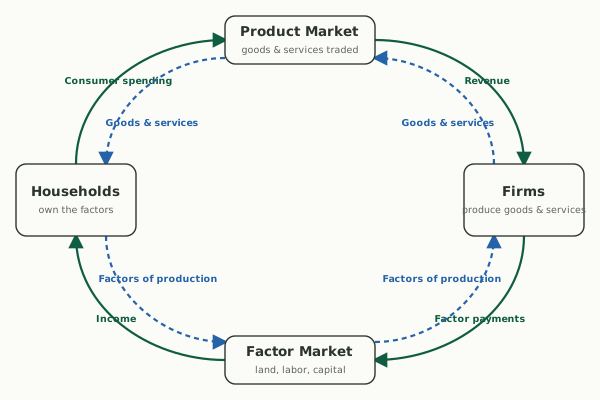
Households sell their labor in the resource market, also called the factor market. This is the market where households, as owners of the factors of production, supply labor, land, capital, and entrepreneurship, and firms are the buyers. In the fill in the blank version of this question, the missing word is firms: households and firms interact in the resource market and the product market, the two markets that make up the circular flow model.
Each factor of production earns a specific payment when it is sold in the resource market. Labor earns wages, land earns rent, capital earns interest, and entrepreneurship earns profit. So the payment for the land factor of production is rent, paid by firms to the households who own that land. These four payments together make up a household's income, and from the firm's side they are a cost of production.
The resource market is only half of the loop. In the product market, the roles flip: firms are the sellers and households are the buyers. Firms use the labor, land, capital, and entrepreneurship they bought in the resource market to produce goods and services, then sell those goods and services back to households. The money households earned in the resource market is the money they spend in the product market.
Picture a single household to see both markets at once. A parent sells labor to a firm and earns a wage; the family also rents out a small plot of land to a business and earns rent. That wage and rent income becomes the household's spending money, which the family then uses in the product market to buy groceries, gas, and a haircut from other firms. The same dollars that flowed out of firms as factor payments flow back into firms as revenue.
What keeps the whole loop moving is money flowing in one direction while resources and goods and services flow in the other. Firms pay wages, rent, interest, and profit to move resources from households to firms, and households pay prices to move goods and services from firms to households. Because spending by one side always shows up as income on the other, the two money flows and the two physical flows keep circling continuously between households and firms.
Go deeper
Related questions
- In the circular flow model, households and blank interact in the resource market and the product market?
- Firms. Households supply labor, land, capital, and entrepreneurship to firms in the resource market, and firms supply goods and services to households in the product market.
- What is paid by firms to the land factor of production in the circular flow of income model?
- Rent. Firms pay rent to households for the use of land, the same way they pay wages for labor, interest for capital, and profit for entrepreneurship.
- What helps the resources and goods and services move around the circular flow?
- Money payments move the circular flow. Firms pay wages, rent, interest, and profit to pull resources from households, and households pay prices to pull goods and services from firms, so money and physical flows circle in opposite directions.
- Is the resource market the same thing as the factor market?
- Yes. Resource market and factor market are two names for the same market, the one where households sell labor, land, capital, and entrepreneurship to firms.
More questions answered
- What is the difference between the current account and the financial account?
- What are the leakages in the circular flow model?
- Which term describes the point when total injections equal total leakages?
- Why do funds flow opposite to goods and services in the circular flow model?
- How is long-run economic growth shown on an AD-AS graph?
Last updated