Can a country consume beyond its production possibilities curve?
Yes, through trade. A country can never produce past its own production possibilities curve, but specializing in the good where it holds a comparative advantage and trading for the other good lets it consume a bundle that sits outside that curve.
Full guide: The PPC, explained with graphs and examples
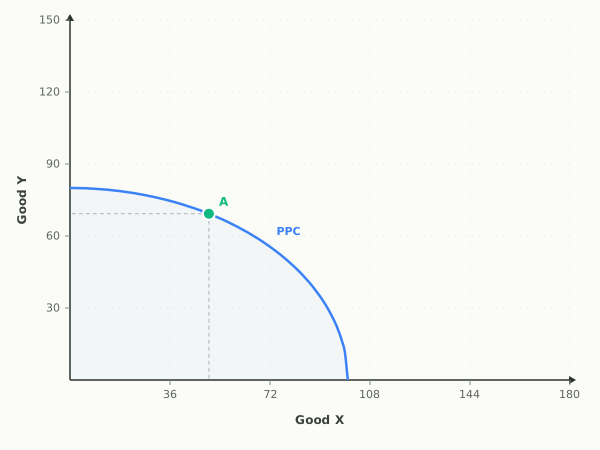
The production possibilities curve plots the maximum combinations of two goods a country can produce with fixed resources and technology, so a country's production point always sits on or inside its own curve; it never sits outside. Trade changes what a country can consume, not what it can produce, by letting the country swap some of one good for more of the other at a rate better than its own opportunity cost.
Take two countries producing computers and shirts. Country A can produce at most 60 computers or 30 shirts, so its opportunity cost of 1 computer is 30 divided by 60, or 0.5 shirts, and its opportunity cost of 1 shirt is 60 divided by 30, or 2 computers. Country B can produce at most 40 computers or 80 shirts, so its opportunity cost of 1 computer is 80 divided by 40, or 2 shirts, and its opportunity cost of 1 shirt is 40 divided by 80, or 0.5 computers.
Comparing the two, A gives up only 0.5 shirts per computer versus B's 2 shirts, so A holds the comparative advantage in computers. B gives up only 0.5 computers per shirt versus A's 2 computers, so B holds the comparative advantage in shirts. Each country specializes fully: A's production point moves to 60 computers and 0 shirts, and B's production point moves to 0 computers and 80 shirts. Both points still sit on each country's own curve.
Workable terms of trade for 1 computer must fall strictly between A's cost of 0.5 shirts and B's cost of 2 shirts. Suppose the two countries agree to trade at 1 computer for 1 shirt, and A sends B 30 computers in exchange for 30 shirts. A's consumption point becomes 30 computers and 30 shirts, and B's consumption point becomes 30 computers and 50 shirts.
Check A's own curve at 30 computers: with 30 of its 60 computers used, A's curve allows at most 15 shirts, yet A is consuming 30. Check B's own curve at 30 computers: B's curve allows at most 20 shirts at that output level, yet B is consuming 50. Both consumption points sit outside the country's own production possibilities curve, while both production points still sit on it. That gap between the production point and the consumption point is exactly what trade buys: had A used its own curve to produce 30 computers instead of specializing fully, it could make only 15 shirts, so trade nets A 15 extra shirts for the same computer output; had B used its own curve to produce 20 computers instead of specializing fully, it could make only 40 shirts, so trade nets B 10 extra computers and 10 extra shirts.
This is why the answer only works through trade and never through production alone. A country's technology and resources cap what it can produce, and no amount of trading changes that cap. What trading changes is the bundle a country gets to keep after specializing in its lower-opportunity-cost good and exchanging the surplus, and that bundle can lie past the country's own curve even though the curve itself never moved.
Go deeper
Related questions
- Does this mean the production possibilities curve is wrong?
- No. The curve still correctly caps what the country can produce on its own. Trade only changes the consumption bundle available after specializing and exchanging goods with another country; it does not move the curve or let the country produce past it.
- What if the two countries have the same opportunity costs?
- Then neither country holds a comparative advantage, there is no gain from specializing, and no terms of trade exist that make both countries better off. Each country is left consuming inside or on its own curve, at whatever point it already produces.
- Why must the terms of trade sit strictly between the two opportunity costs?
- At or beyond its own opportunity cost, a country gains nothing from trading, since it could get the same rate by producing the good itself. Only a rate strictly between the two countries' opportunity costs makes both sides better off than producing alone.
- Is the gain from trade the same for both countries?
- Not necessarily. In the example, Country A gained 15 shirts while Country B gained 10 computers and 10 shirts, because the agreed rate of 1 computer for 1 shirt sat closer to A's own opportunity cost than to B's. A rate near the middle of the range splits the gains more evenly.
More questions answered
Last updated