Why do funds flow opposite to goods and services in the circular flow model?
Money is the payment for the goods and factors moving the other way. Households pay firms for output in the product market, and firms pay households for labor and other inputs in the factor market, so every real flow has a matching money flow running backward.
Full guide: The circular flow model, diagram and leakages
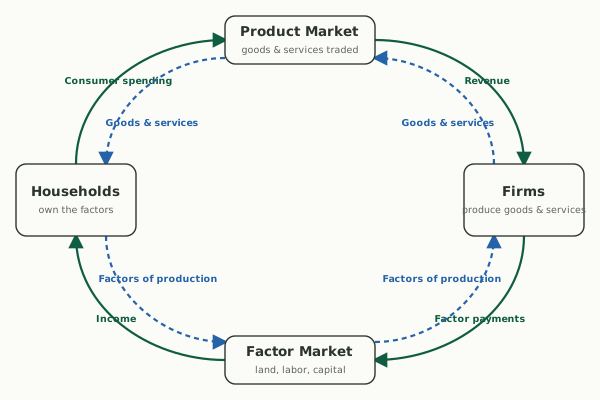
The circular flow model has two loops, and in each one, money moves in the direction opposite the thing it is paying for. That is not a quirk of the diagram; it is what a payment is. A payment always travels from the party receiving something to the party giving it up, so if you draw both the real flow and the money flow on the same loop, they point in opposite directions by definition.
Take the product market first. Firms send finished goods and services outward to households. Households send money back to firms in exchange, as spending on those goods and services. The goods move from firm to household; the payment moves from household to firm. Same loop, opposite direction.
The factor market works the same way in reverse roles. Households supply the inputs firms need: labor, land, capital, entrepreneurship. That real flow moves from household to firm. Firms pay for those inputs with wages, rent, interest, and profit, and that money flow moves from firm to household. Again, the real resource and its payment travel opposite paths around the same loop.
A concrete example makes this easy to hold onto. A student works a part-time job at a local bakery. The student is a household supplying labor, a factor of production, to the bakery, a firm; that labor flows to the firm. The bakery pays the student a wage; that money flows back to the household. Later the same student buys a loaf of bread from that bakery. The bread, a finished good, flows from the firm to the household. The dollars the student hands over flow from the household to the firm. Two transactions, two loops, and in both the money went the opposite way from the item it paid for.
The most common exam mix-up is treating the factor market and the product market as if they had the same direction of flow, or forgetting that households are suppliers in one market and buyers in the other. On free-response questions, state plainly which market you mean and which party is sending the real flow versus the money flow; graders are checking that you can name both, not just that you know a payment happened. A second common error is drawing money and the good moving the same way around one arrow. If a diagram shows a single arrow doing both jobs, the direction it points has to be picked for either the real flow or the money flow, never both, since they run opposite ways.
For the full two-loop diagram, the leakages and injections that expand it into the full circular flow model, and a labeled walkthrough of both markets, see the complete explainer: The Circular Flow Model, Explained.
Go deeper
Related questions
- Does money flow the same direction in the product market and the factor market?
- In both markets money flows opposite to whatever real thing it is paying for, but the direction relative to households and firms differs. In the product market, money flows from household to firm. In the factor market, money flows from firm to household.
- What is actually flowing in the opposite direction from money in each loop?
- In the product market, goods and services flow from firms to households, opposite the household-to-firm payment. In the factor market, labor and other factors of production flow from households to firms, opposite the firm-to-household payment.
- Why does this matter for AP Macroeconomics exam questions?
- Free-response questions often ask you to identify a flow in a named market. Getting the direction backward, or mixing up which market you are describing, is one of the most common ways points are lost on circular flow items, so naming the market and the party sending each flow is worth doing explicitly.
- If goods, services, and resources all flow one way in the circular flow model, what flows in the opposite direction?
- Money. Spending on goods and services flows from households to firms, opposite the goods and services, and income (wages, rent, interest, and profit) flows from firms to households, opposite the resources households supply.
More questions answered
- What is the difference between the current account and the financial account?
- What are the leakages in the circular flow model?
- Which term describes the point when total injections equal total leakages?
- In which market do households sell their labor?
- How is long-run economic growth shown on an AD-AS graph?
Last updated