What does a point inside the PPC represent?
A point inside the production possibilities curve represents an inefficient use of resources: the economy is producing less of both goods than it could, usually because of unemployment or idle capital. A point on the curve is efficient; a point outside it is currently unattainable.
Full guide: The PPC, explained with graphs and examples
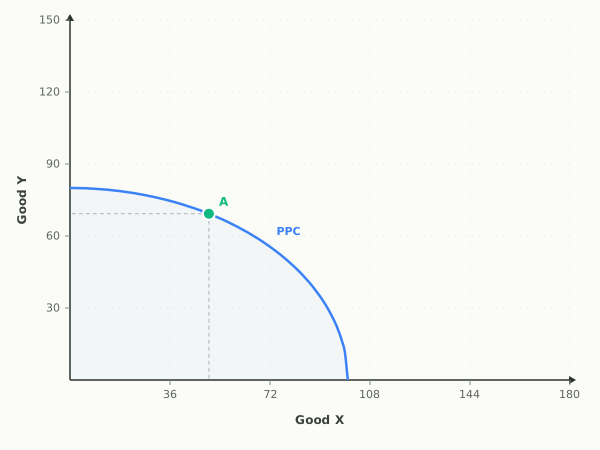
A production possibilities curve (PPC) plots every combination of two goods an economy can produce when it uses all its resources fully and with the best available technology. Where a point sits relative to that curve tells you something specific about how the economy is performing, and AP graders look for all three cases stated correctly: inside means inefficient, on means efficient, outside means currently impossible.
Take an economy that can produce a maximum of 100 units of wheat or 50 units of cloth, with a straight-line frontier between those extremes. A point at 40 wheat and 15 cloth sits inside that frontier, because the curve at 40 wheat allows up to 30 cloth. The gap between 15 and 30 is the output the economy is leaving on the table. Resources exist to make more of both goods, but they are sitting unused or badly matched to the jobs available. That is what "a point inside the PPC" means: idle or misallocated resources, not a resource limit.
The two textbook causes are unemployment and underused capital. If workers are laid off, or factories run below capacity, or land sits fallow, the economy produces less than its frontier allows and the point plotted falls inside the curve. A recession is the clearest real-world case: as spending and output fall, both goods (or the whole economy's mix of goods) are produced below capacity, and the point representing the economy moves inward, from the frontier toward the origin. Recovery moves the same point back out toward the curve, without the curve itself shifting, because the recovery uses resources and technology the economy already had.
By contrast, a point exactly on the curve, such as 70 wheat and 15 cloth on the same frontier, is productively efficient: every resource is employed, and the only way to produce more cloth is to produce less wheat. A point outside the curve, such as 90 wheat and 40 cloth, is unattainable right now, not because it is inefficient but because current resources and technology cannot reach it.
The frontier itself only moves with economic growth: more resources (a larger labor force, new capital, newly discovered land) or better technology push the whole curve outward, so that combinations once outside the old curve become reachable points on or inside the new one. Growth is a shift of the curve. Recovering from a recession is a movement of a single point back toward a curve that never moved. Mixing up those two mechanisms, shifting the curve when only the point should move, or vice versa, is one of the most common mistakes on PPC free-response questions.
For the fully worked graph, including how comparative advantage and opportunity cost show up on the same diagram, see the production possibilities curve explainer. To practice computing the opportunity cost of moving between two points on a frontier, use the opportunity cost calculator.
Go deeper
Related questions
- Is a point inside the PPC good or bad?
- It is bad in the sense of wasted potential: resources are unemployed or misallocated, so the economy could produce more of at least one good without giving up any of the other. It does not mean the economy has fewer resources, only that it is not using the resources it has.
- Does a point inside the PPC mean the same thing as a recession?
- A recession is one common cause of a point moving inside the PPC, since output and employment fall below capacity. But any source of idle or badly matched resources, not only a recession, can put the economy inside its frontier.
- What is the difference between a point inside the PPC and a point on it?
- A point inside the PPC is achievable but wasteful: some resources sit idle. A point on the PPC is achievable and uses every resource fully, so producing more of one good requires producing less of the other. Only points on the curve are productively efficient.
- Can an economy move from inside the PPC to on the PPC without the curve shifting?
- Yes. Putting idle resources back to work, for example hiring unemployed workers or restarting idle factories, moves the plotted point outward toward the existing frontier. The frontier itself only shifts with growth in resources or technology.
- What happens when production is inside the production possibilities curve?
- The economy produces less than it could. Producing somewhere inside the curve means resources are unemployed or misallocated, so the economy could produce more of at least one good without giving up any of the other.
More questions answered
Last updated