What does the circular flow model show?
The circular flow model shows how households and firms exchange goods, services, resources, and money. The fuller version adds the government and the rest of the world, moving through the product market and the factor market.
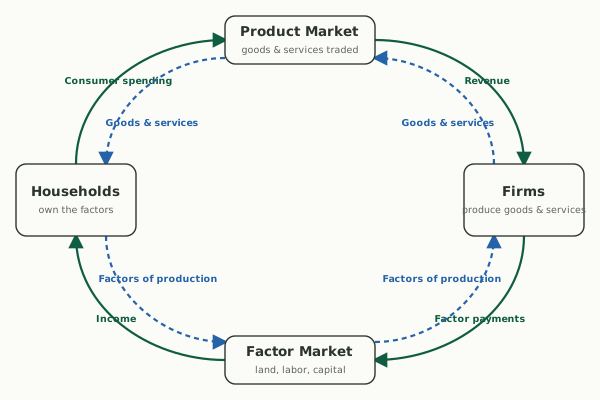
The circular flow model shows how the parts of an economy connect. In its basic form, households and firms trade with each other in two markets. In its fuller form, the government and the rest of the world join the diagram as two more sectors, but the underlying idea does not change: money and real goods keep moving in opposite directions around the same loop.
The product market is where firms sell the goods and services they produce and households buy them. Households hand over money as spending, and firms hand over the output, so this half of the loop runs in both directions between the same two groups.
The factor market is where the direction flips. Here households are the sellers: they supply labor, land, capital, and entrepreneurship to firms. Firms pay for those resources with wages, rent, interest, and profit, which together become household income.
This is why the model is drawn with two flows running opposite ways. Real goods and resources move one direction around the loop (resources from households to firms, output from firms to households), while money moves the other direction (spending from households to firms, income from firms to households). Every dollar households earn in the factor market eventually gets spent back into the product market, which is the basic circle the name describes.
The fill-in-the-blank version of this question usually reads: the circular flow shows how households, businesses, and the government interact in an economy. When the government sector is added, it collects taxes from both households and firms and returns spending as transfer payments, purchases of goods and services, and factor payments to its own employees. A full diagram can add a fourth sector, the rest of the world, connected through exports and imports.
What the model leaves out matters for exam questions too. The circular flow shows the direction of exchange, not the size of any flow, so it says nothing about GDP growth, inflation, or unemployment. It also does not show financial markets such as saving and borrowing unless a version explicitly adds that leakage and injection. Students who try to use the basic two-sector diagram to explain a recession or a tax cut's effect on output are asking it to do a job it is not built for; that work belongs to the aggregate demand and supply model instead.
Go deeper
Related questions
- What are the two markets in the circular flow model?
- The product market, where firms sell goods and services to households, and the factor market, where households sell resources such as labor to firms.
- What goes in the blank: the circular flow shows how households, businesses, and the ___ interact in an economy?
- Government. The full circular flow model adds the government sector, which taxes households and firms and returns spending as purchases, transfers, and factor payments.
- Does the circular flow model show economic growth?
- No. It shows the direction that goods, resources, and money move between sectors, not the size of those flows or whether output is rising or falling.
More questions answered
Last updated