What shifts the production possibilities curve (PPC)?
A change in the quantity or quality of resources, or a change in technology, shifts the whole production possibilities curve: outward for economic growth, inward for a loss of resources. A PPC showing economic growth shifts outward, away from the origin.
Full guide: The PPC, explained with graphs and examples
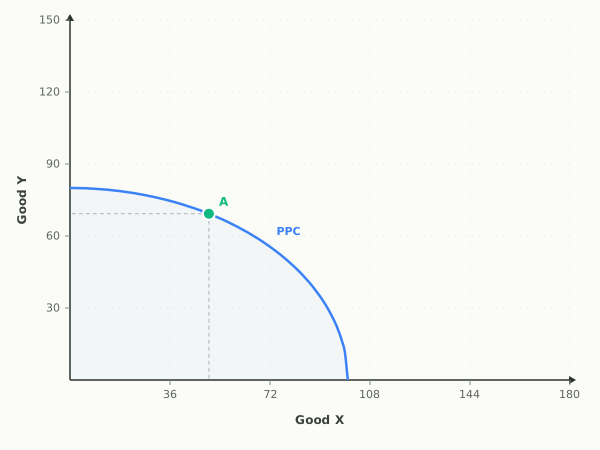
A shift is different from a movement along the curve. Moving along an unchanged PPC just reallocates the same fixed resources between two goods, trading more of one for less of the other. A shift redraws the whole boundary of what the economy can produce, because the resources or the technology behind both goods have changed.
Three things shift the curve: more resources, better resources, and better technology. More labor, more capital, or newly discovered natural resources push the frontier outward. A more educated or better trained workforce, meaning higher human capital, does the same without adding a single worker. A new production method or invention lets the economy squeeze more output from the same inputs, which also shifts the curve out.
A shift does not have to move the whole curve evenly. A resource or a technology that only helps produce one of the two goods pushes out just that axis intercept, pivoting the curve rather than sliding it outward in parallel. A fertilizer breakthrough that only helps grow wheat extends the wheat intercept and leaves the tractor intercept where it was.
The curve shifts inward when the economy has less to work with: a war or natural disaster that destroys capital, a shrinking labor force, or a drop in the resource base all pull the frontier back toward the origin. Losing productive capacity is the mirror image of growth, and it is graded on the same curve, just moving the other way.
Unemployment and a recession do not shift the PPC at all. An economy operating below its potential is producing at a point inside the curve, not on a curve that has moved. The boundary of what the economy is capable of has not changed, only how much of that capacity is being used. That inside point can move back out toward the existing curve without any shift, just by putting idle resources back to work.
This is also the answer to the fill in the blank version of the question. A production possibilities curve showing economic growth is one that shifts outward, or away from, the origin, since growth means the economy can now produce more of both goods than it could before.
Go deeper
Related questions
- Does a shift and a movement along the PPC mean the same thing?
- No. A movement along the curve reallocates the same fixed resources between two goods and stays on the same boundary. A shift changes the boundary itself because the underlying resources or technology changed.
- Can the PPC shift on only one axis?
- Yes. If a change in resources or technology only helps produce one of the two goods, only that good's intercept moves outward, pivoting the curve instead of shifting it out in parallel on both axes.
- Does a recession shift the PPC inward?
- No. A recession moves the economy to a point inside an unchanged curve because resources sit idle. The curve itself only shifts inward when the resource base or technology is actually lost, not when existing capacity goes unused.
- Which direction does the PPC shift for economic growth?
- Outward, away from the origin. Economic growth means the economy's maximum possible output of both goods has increased, so the entire frontier moves further from the origin than before.
More questions answered
Last updated